Micro-LED and mini-LED tech is taking over screens. Not the old kind. These emit tiny red, green, andblue lights separately. Better accuracy. Richer blacks. More contrast. Your old OLED feels dated fast.
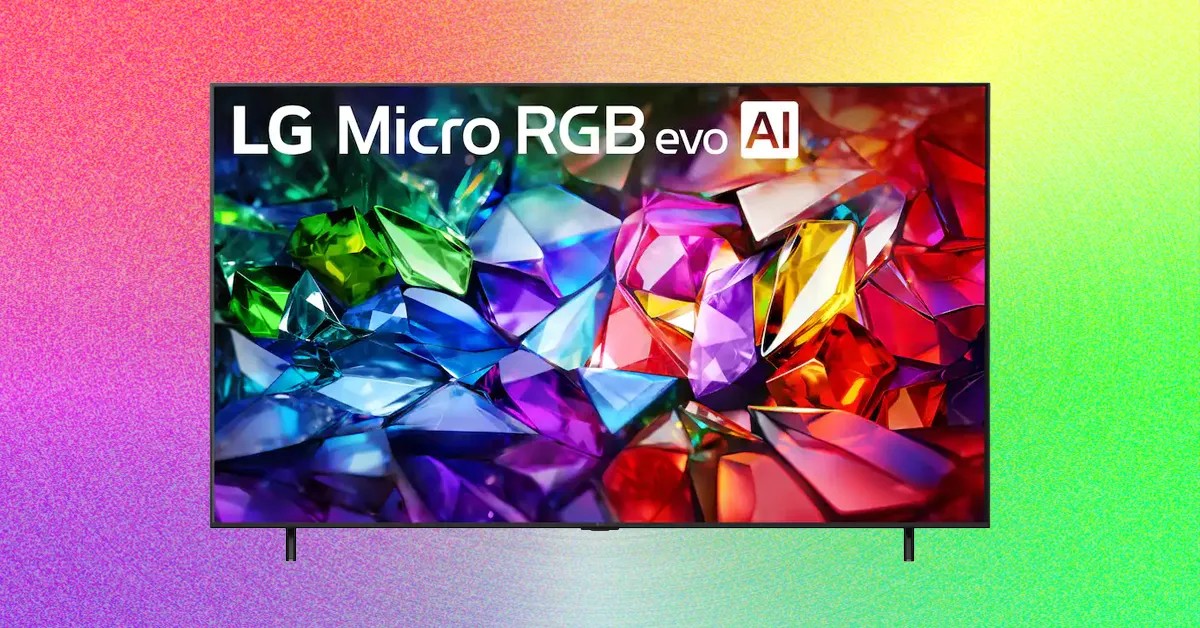
The LG Micro RGB Evo is the newest entry.
I tested the 75″ model. It costs $5,00088.6 pounds. Heavy. I needed help lifting it. Setup was easy though. The legs popped on. Two screws. It sits on my 65″ stand without issues.
Other sizes exist. The 86″ is $7,000. The 100″ hits $8,000.
The market is crowded. You have the Samsung R95H for $3,000 (65″). TCL offers an RGB Mini-LED for $6,000 (85″). Hisense has the UR9 for $2,200. Sony’s Bravia 7 MarkII runs $2,600.
Here is the catch. The Hisense and Sony use “mini” RGB. The LG and Samsung use “micro.” Micro means smaller LEDs. More control. Better precision. The difference? Debatable. But after testing all four. LG and Samsung win on pure picture quality.
The real question isn’t quality. It’s price. Is LG worth the extra cash?
Settings Matter More Than Specs
If the goal is a home cinema look you have to scale back settings first.
The design is stark. Dark gray bezels. Black face. Flush against the wall if you mount it. I didn’t. Too heavy.
Ports are decent. Four HDMI 2.1. One for eARC. Ethernet. Optical. Coax. Two USBs. Wi-Fi 5 is the weak link. Hisense uses Wi-Fi 6e. LG? Stuck in the past.
And the interface. WebOS 26. No Google TV here. I dislike it. Too many pre-installed apps. Why do I need a webcam app? Or five different free TV services? Just give me Netflix and Apple TV.
The remote is bad.
Cursor jumps. Home button is off-center. Hard to find in the dark. Muting requires holding the volume down. It mutes the TV speaker but not the connected audio. Weird.
But LG hides some tricks.
Auto power-on when you walk in works perfectly. “Live Plus” off stops tracking what you watch. Voice control helps with contrast settings. Search for “Malice” though and it suggests paid rentals over Tubi. Stupid bot.
Color support is top-tier. 100% BT.2020. DCI-P3. Adobe RGB. Most movies don’t hit BT.2020 anyway. But Guardians of the Galaxy Vol 2? Inside Out? Both on Disney+ blew my mind. So much color.
Picture Quality Tests
Spears & Munsil benchmark first.
Skin tones on the LG crushed the Hisense. The Sony. The TCL. No washed-out faces. Nice gradations.
Green grass behind a fence looked real. Yellow flowers popped. Sunset scenes were vibrant proof micro-LED is working. OLED still wins on pure black contrast though. Black trees on dark mountains stayed black.
But modes change everything.
Filmmaker mode? Accurate but dull. Vivid or Cinema Home mode makes dark colors sing. Brown. Purple. White mist on snow becomes clear only in these modes.
I tested Awake on Netflix. Dark bicycle scene. Normal LEDs turn it to mush. LG in Vivid mode beat my OLED on contrast. Too much saturation though. Easy to fix. LG gives dozens of tint and white-balance tools. I dialed it back.
The Creator on Fandango At Home looked nice. Predawn ocean blue was visible.
Tron Ares beat Hisense on deep reds. But only in Vivid.
Wish to save money? The Hisense UR9 holds its own.
The Last Duel looked more realistic on the Hisense. Project Hail Mary planet rings were vivid on the cheaper set. Hoppers? Looked better on the LG. But honestly that film is so bright it would look fine on an iPhone screen.
Streaming had hiccups. Dune part 1 via Google Cast and HBO Max? Dolby Atmos worked. Good Luck Have Fun Don’t Die on Hulu via AirPlay to an iPad? Broke. LG says they’re investigating.
Older movies usually look terrible on new tech. Blink from the 90s on Tubi looked surprisingly crisp though. Better than some modern LED sets.
Games. Sports. And Glitches.
Subnautica 2 on Xbox Series X triggered Game Optimizer. 120Hz kicked in. Colors were amazing. Green and blue rocks underwater looked real. Only in Vivid modes.
Hellblade II improved too. Contrast helped a shipwreck level. Water on the protagonist’s arms wasn’t gray sludge like on cheaper sets. It was real water.
Forza Horizon 6 looked good on Xbox. But moving to a laptop showed the LG’s true speed. 165Hz native. Low latency. The speedboat in One 007: First Light was jaw-dropping.
VRR mode promised 330Hz. “Motion Booster” LG calls it.
Big mistake.
Flickering. Rainbows. Every PC game. Crimson Desert? Unplayable. I hid the setting deep in menus and disabled it. Back to 165Hz. No more flickering. LG says they know about the bug.
Sports were sharp. World Cup matches on YouTube TV showed accurate jerseys. No blur on the ball. CNN live feed was too vivid. I used Game Optimizer ironically to flatten the colors.
Screensavers exist too. LG Gallery+ costs $5 a month. 4500 images. I loaded shipwreck paintings. No texture. Just color. It’s art without soul.
The Verdict
LG Micro RGB Evo matches OLED if you tweak settings. It falls short of pure OLED impressiveness.
Cost is the issue. It’s double the price of the Hisense 65″ UR9.
You won’t get double the quality.
Colors are vibrant. Bold. To get cinema dark you have to dial it back. Tweak it. Fix the saturation.
If you fix that the LG shines. Truly.
Want the best Micro RGB tech available? You can’t go wrong with LG.
But are you ready to pay twice as much for what you could buy cheaper elsewhere?