
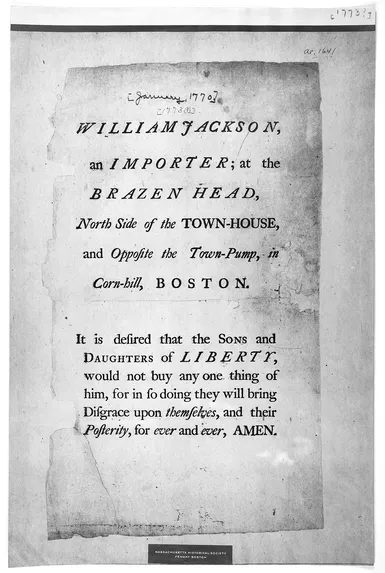
See the document from January 1770. It is an urgent appeal to the “sons and daughters of liberty.” The message is clear: don’t buy anything from William Jackson. Why? Because this Boston merchant ignored the colonial boycott of British imports. He broke the rules. The Library of Congress has a copy of this historical artifact, a snapshot of economic warfare.
These were the Colonial Non-Importation Agreements. From 165 to 1775, the American colonies tried to force Britain to recognize their political rights. They used financial pressure. The goal was simple. Stop buying English products. Let it hurt.
The first wave came after the 1765 Stamp Act. The second followed the Townshend Acts of 1767. The organizers were mainly Sons of Liberty and Whig merchants. They started clubs. These groups coordinate boycotts. The plan was based on mutual suffering. If the colonists stopped buying, the British merchants would lose money. These merchants lobbied the parliament. Parliament repeals the violated laws.
It somehow worked. British trade with the colonies was restricted. Manufacturers felt the crisis. Parliament gave up. The laws were repealed. But as soon as the pressure subsided, the boycotts collapsed. There was no permanent structure. Only a temporary reaction.
Then came the intolerable acts of 1774. This time, the first continental congress was organized. They immediately set up non-import and export committees. The strategy had evolved. It was no longer just a local protest. It was continental politics.
This is where the plan failed. Britain had changed. During the decade of boycotts, British merchants found new markets in Europe. They adapted. They took the colonial losses. The expected effect on the parliament did not materialize this time. The economic weapon was blunt and eventually dull.
For ten years, non-importation was the main weapon. The colonies tried to enforce their demands through peaceful means. It didn’t work. The British economy proved too resilient. Political influence was not enough. Boycotts undermined colonial solidarity more than harmed British trade.
Why did they keep trying? Because it was the only tool they had. Violence was a last resort. They wanted a solution that kept the empire intact but respected their rights. The data shows otherwise. The mechanism was faulty. Compromises were ignored.
Boycotts brought unity to the colonies. They also created resentment against those who broke them, such as William Jackson. Social costs were high. The economic effects on Great Britain were manageable. The political result was zero.
The lesson is not that collective action is useless. The reality is that economic pressure have their limits. Especially if the target has other options. Britain had Europe. The colonies had Britain. But the colonies were more dependent. The asymmetry was fatal to the strategy.
We are still talking about boycotts. We await the results. We hope for change. History suggests that we should be careful. Pain must be felt where it matters. And sometimes the pain is spread too thin. The 1770 document is a warning. It’s about more than just William Jackson. It’s about the limits of peaceful coercion.
What happens when the other side adapts? The colonists found out. The answer was not pretty. It