The action camera market saw little innovation in late 2025, with GoPro and Insta360 largely sticking to existing models. However, DJI stepped up with the Osmo Action 6, a notable update that addresses key shortcomings of its predecessor and solidifies its position as a top contender. Despite geopolitical uncertainties surrounding DJI’s products, including potential restrictions on support, the Action 6 delivers compelling improvements in video quality, usability, and features.
Enhanced Performance and New Features
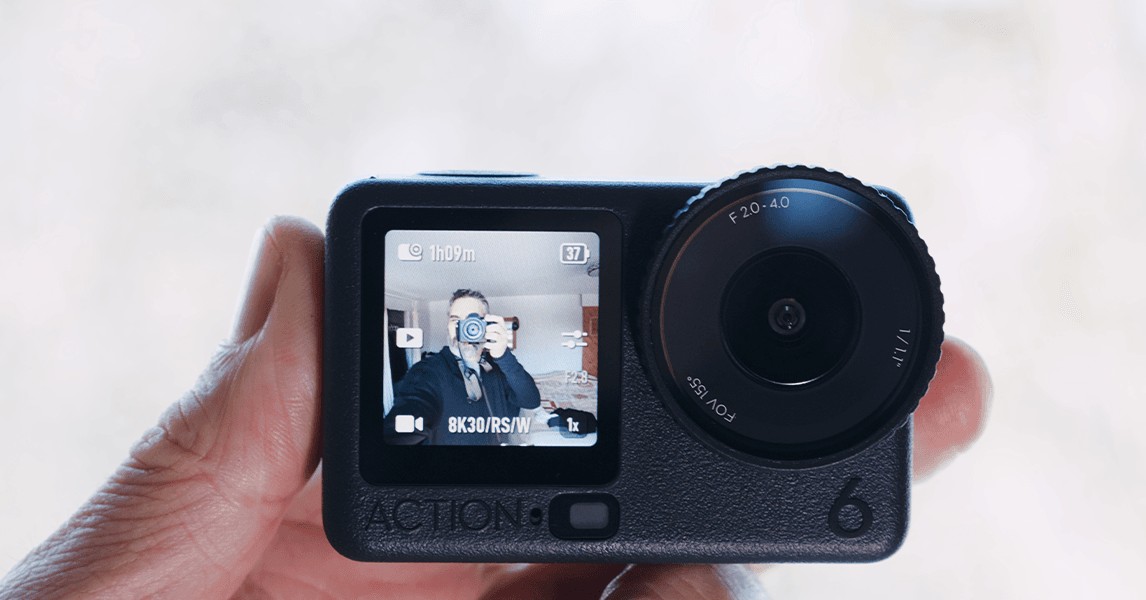
The Osmo Action 6 builds upon the strengths of the Action 5 Pro, which already stood out for its low-light performance, compact design, and battery life. The new model introduces a larger 1/1.1-inch square sensor, enabling better color rendering, increased dynamic range, and versatile cropping options. Crucially, the Action 6 now supports 8K video recording at 30fps (enabled via a firmware update in late 2025), lossless 2x zoom, and a variable aperture lens (f/2 to f/4) for improved low-light capture without excessive depth-of-field loss.
These upgrades matter because action cameras are increasingly used in low-light environments, from indoor sports to dusk/dawn outdoor activities. A variable aperture gives users more creative control without forcing them to rely on software post-processing.
Improved Usability and Design
DJI addressed minor but persistent annoyances from the Action 5 Pro. The magnetic mount is now non-directional, eliminating the frustration of misaligning the camera. Stabilization has been refined; it crops less of the field of view, delivering wider shots with stabilization enabled. Horizon leveling can now be set to 45 or 360 degrees, adding versatility for dynamic shots.
The inclusion of interchangeable lenses, similar to GoPro, expands the Action 6’s capabilities. A $146 Boost Lens increases the field of view to 182 degrees, with automatic recognition when attached. However, ND filters still require manual adjustment, unlike GoPro’s system.
Superior Low-Light Performance and Color Accuracy
The larger sensor significantly improves low-light performance. Video is cleaner and sharper than both the Action 5 Pro and Insta360 Ace Pro 2, even without SuperNight mode. Shooting in D-Log reveals brighter, more detailed footage, offering a noticeable improvement in color accuracy and shadow detail. Lens flares are reduced, and the aperture blades create decent sun stars.
This matters because many action cameras struggle in low-light conditions, producing grainy or washed-out footage. The Action 6 excels here, making it suitable for a wider range of shooting scenarios.
Durability Concerns and Long-Term Reliability
The variable aperture introduces a potential point of failure. While DJI likely tested this mechanically, real-world use (especially in high-vibration environments like bike mounts) could lead to issues over time.
Is It Worth the Upgrade?
If you own the Action 5 Pro, the upgrade is worthwhile for the improved low-light performance and non-directional magnetic mount. The Action 6 surpasses the Insta360 Ace Pro 2 in 10-bit Log capabilities and low-light performance. The choice between the Action 6 and GoPro Hero 13 Black depends on preference: GoPro for realistic color science, Action 6 for superior low-light and battery life.
Ultimately, the Osmo Action 6 is the best overall action camera currently available, thanks to its low-light performance and well-rounded feature set. The action camera market is evolving, but DJI has set a new standard with this latest release.