
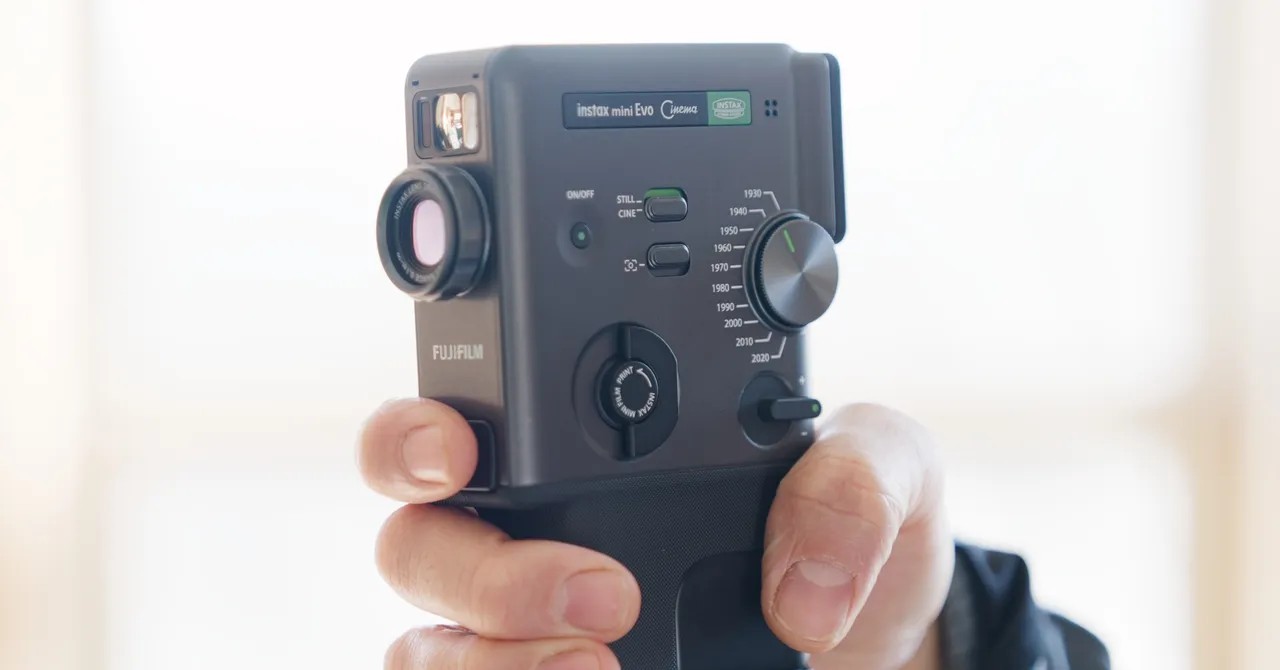
Fujifilm’s latest Instax release, the Mini Evo Cinema, isn’t just another instant camera—it’s a nostalgic deep dive into the history of film. The camera deliberately mimics the look and feel of 1960s cine cameras, complete with a “Decades” dial that cycles through era-specific visual effects. While image quality isn’t the priority, the Evo Cinema delivers on its core promise: tactile, retro-inspired fun with instantly printable results.
Design & Ergonomics
The Evo Cinema is the largest Instax model to date, with a tall, slender form factor that takes some getting used to. The grip, while included, still feels awkward without extra support. However, the camera features a standard 1/4-inch tripod mount—a welcome addition often missing from Instax models.
Storage is handled via a USB-C port and a microSD card slot (strongly recommended). The built-in memory is functional, but transferring images is cumbersome. Using a microSD card simplifies this process immensely.
Image & Video Quality
The camera uses a 5-MP, 1/5-inch sensor (identical to the Mini Evo Plus) capable of recording stills at 1920 x 2560 pixels and videos at 600 x 800 pixels. A higher-quality mode boosts video resolution to 1080 x 1440 pixels, but the sensor remains best suited for Instax prints and casual social media sharing.
The shutter button functions as a trigger, recording up to 15 seconds continuously or with single presses. The autofocus lens (28mm equivalent, f/2.0) offers face recognition, though manual control is limited.
The “Eras” Dial & Effects
The Evo Cinema’s standout feature is its “Eras” dial, which applies decade-themed effects to both stills and videos. From the grainy black-and-white aesthetic of the 1930s to the low-fidelity VHS look of the 1990s, the effects are surprisingly convincing. Fujifilm even includes a neutral “2020s” mode that applies no effects, a wry acknowledgment of modern digital clarity.
These effects are permanent, however. Once applied, they cannot be removed from the footage.
Printing & App Integration
Like all Instax cameras, the Evo Cinema prints instantly to Fujifilm’s mini film. Video can be paused during playback and printed as a still frame, complete with a QR code linking to the full video on Fujifilm’s website. However, this integration requires a constant smartphone connection for uploading and sharing.
Performance & Battery Life
The camera suffers from poor battery life, often draining within an hour of moderate use. Data transfer is also slow, further exacerbating the issue. The device asks for confirmation before saving video clips, which leads to accidental deletions if missed.
Verdict
The Fujifilm Instax Evo Cinema is a niche product. If you value retro aesthetics and tactile enjoyment over technical perfection, it delivers on its promise. However, at a higher price point than other Instax models, the Evo Cinema is a luxury item. For those seeking a similar experience with better performance, the Camp Snap CS-8 offers a compelling alternative with a larger sensor and fewer limitations.
Ultimately, the Evo Cinema is a playful, well-designed camera that doesn’t take itself too seriously—and that’s precisely its charm.