


















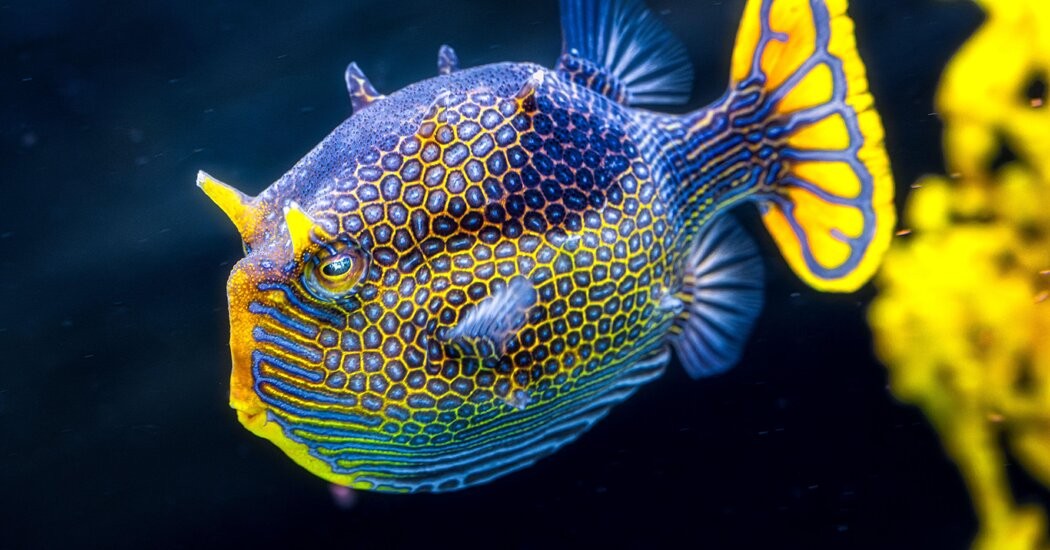
Boxfish, with their charming pouting mouths and diverse, vibrant patterns, have long captivated scientists and enthusiasts alike. But for two engineers at the University of Colorado Boulder, the seemingly random spots, stripes, and hexagonal designs of one species—the ornate boxfish—presented a different kind of intrigue: a mathematical puzzle rooted in decades-old work by Alan Turing, often hailed as the father of modern computing.
Decoding the Patterns: Turing’s Model and Biological Reality
Siamak Mirfendereski and Ankur Gupta recently unveiled a new mathematical model capable of accurately recreating the ornate boxfish’s skin patterns, even incorporating the natural imperfections found in nature. This model bridges the gap between mathematical models and the complex beauty of biological reality, according to Dr. Gupta. Ultimately, this research may lead to advancements in areas such as bio-inspired camouflage fabrics and soft robotics – machines built with flexible materials instead of rigid hardware.
The model builds upon a theoretical framework that Turing published in 1952. Turing’s work examined the interaction between diffusion – the process of particles spreading into less populated areas – and the chemical reactions those particles undergo. While diffusion typically leads to uniformity (think of a drop of food coloring spreading through water), Turing theorized that the combination of diffusion and chemical reactions could cause particles to spontaneously organize into patterns like stripes, spots, and hexagons. These formations are now known as Turing patterns.
Beyond Idealized Simulations: Capturing Natural Imperfections
The mathematics underlying Turing patterns have been used to explain phenomena ranging from leopard spots and seashell swirls to human fingerprints and the spread of matter across galaxies. While computer programs can simulate diffusion and reaction processes to replicate some biological patterns, Dr. Gupta notes that existing simulations often produce results that are too idealized, failing to reflect the variations and imperfections found in nature.
Dr. Gupta’s group faced a specific challenge: simulating the sharp edges of boxfish patterns. “A diffusive system is, by definition, diffuse,” he explained. “So how can you get sharp patterns?” A student’s insight in 2023 provided the solution: incorporating a different type of cell movement into the simulation, known as diffusiophoresis. This process, which also helps soap pull dirt out of clothes during washing, allows cells to clump and move together, driven by the motion of diffusing particles.
The resulting simulations accurately replicated the imperfections observed on real boxfish, including variations in stripe thickness, broken lines, and uneven hexagon formations. While these imperfections can be fine-tuned, Dr. Gupta acknowledges that the simulation is still a simplified version of reality. It doesn’t account for all the complex interactions between cells and lacks specifics about pigment production and other biological mechanisms.
Turing’s Enduring Legacy and Future Applications
Despite its limitations, Turing’s original model—and the refined simulations stemming from it—laid a foundation for controlling pattern formation in both biological and non-biological applications. Researchers have used it to engineer patterns in bacterial colonies, rearrange zebrafish stripes, develop more efficient saltwater filters, and analyze human settlement trends.
“We learn how biology does it so that we can replicate it,” Dr. Gupta stated, adding that his primary motivation was simply curiosity. He is eager to understand how nature creates “the imperfect but distinctive patterns that have fascinated biologists for decades.”
The research demonstrates that even seemingly random designs in nature can be understood through the lens of mathematics, highlighting the enduring relevance of Alan Turing’s work and its potential to inspire future innovations. Ultimately, by unlocking the secrets behind these patterns, scientists hope to not only deepen our understanding of the natural world but also develop novel technologies inspired by its ingenuity