
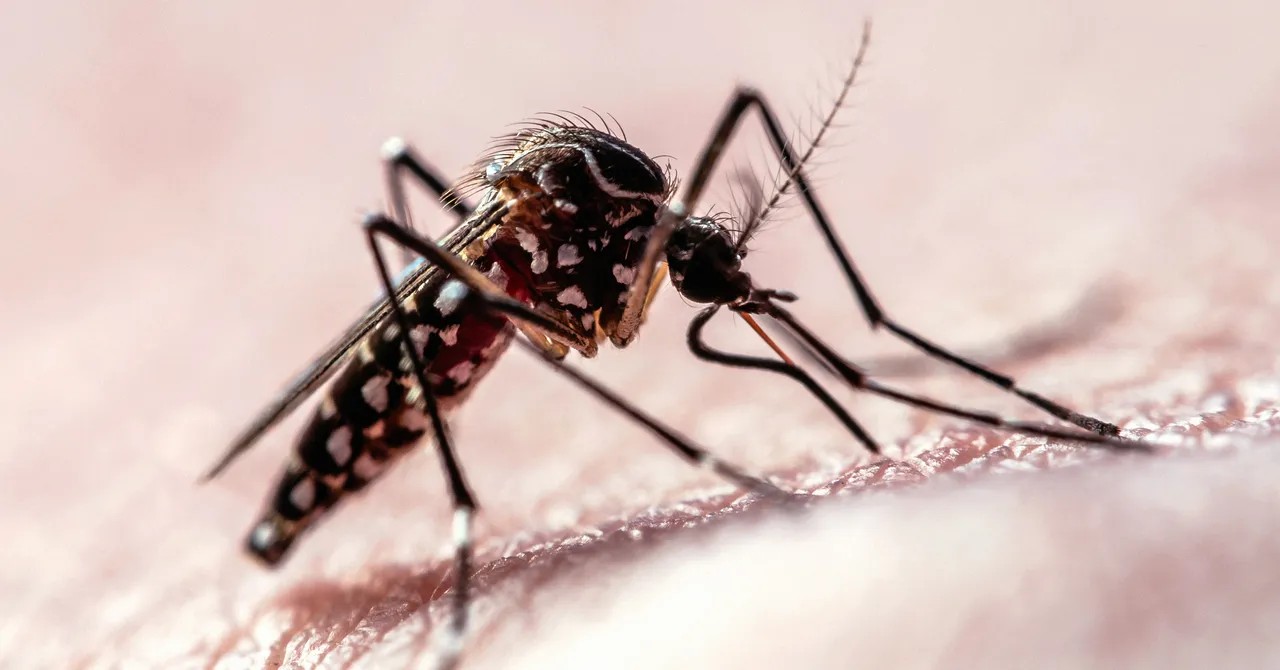
Mosquito-borne diseases—including malaria, dengue, and Zika—are a global health crisis, claiming more than 770,000 lives every year. While we have long known that mosquitoes are attracted to humans, the exact “flight logic” they use to navigate from a distance to a landing site has remained a mystery.
A collaborative research team from the Georgia Institute of Technology and MIT has now cracked this code. By applying advanced Bayesian inference—a statistical method used to find the most likely patterns in complex data—researchers have developed a mathematical model that accurately predicts mosquito movement using fewer than 30 key parameters.
The Data Behind the Discovery
To build this model, researchers conducted an unprecedented scale of observation. Using two infrared cameras, they recorded the flight paths of Aedes aegypti mosquitoes in 0.01-second increments. The resulting dataset is massive:
– 53 million data points
– 400,000 individual flight paths
– 20 controlled experiments
This sheer volume of data allowed the team to move beyond mere observation and into precise, quantitative science.
Two Modes of Flight: Active vs. Idle
By analyzing movement in environments without external stimuli, the researchers identified two distinct behavioral states:
1. The Active State: The mosquito actively explores its surroundings, maintaining a steady speed of approximately 0.7 meters per second.
2. The Idle State: The mosquito flies with almost no thrust, often hovering near ceilings. This is believed to be a “preparation stage” for landing.
The Sensory Tug-of-War: Vision vs. Chemistry
The core of the study lies in how mosquitoes integrate different environmental signals. The researchers found that mosquitoes do not rely on a single sense, but rather a complex interplay of visual and chemical cues.
1. The Visual Factor (Darkness)
In experiments where subjects wore different colors, mosquitoes ignored body odor and heat if the subject was dressed in white, instead concentrating heavily on the side dressed in black. This proves that in still air, visual stimuli are a primary driver for finding a target. However, vision alone is not enough; mosquitoes often approach a dark object but fly away if they don’t detect other cues.
2. The Chemical Factor (CO2)
Carbon dioxide (CO2) acts as a high-precision beacon. When mosquitoes enter a 40cm radius of a CO2 source, their behavior shifts dramatically: they slow down to 0.2 m/s and begin flying erratically, swaying as they attempt to pinpoint the source. They can detect concentrations as low as 0.1% from up to 50cm away.
3. The “Synergy” Effect
The most critical finding is that vision and CO2 are not additive; they are synergistic. When both stimuli are present, the mosquito’s response is much stronger than the sum of its parts. The mosquitoes begin to circle the target, staying much closer and longer than they would with just one cue. This suggests that the mosquito’s brain integrates these different sensory inputs to make a single, unified decision.
Why Your Head is a Target
The study provides a scientific explanation for a common observation: mosquitoes seem to target the human head.
Using their new mathematical model, researchers simulated a “black sphere emitting CO2” (representing a hooded head) and found it perfectly predicted mosquito density. The human head is a “perfect storm” for a mosquito: it appears dark to their eyes and is a concentrated source of CO2 from breath.
Implications for Global Health
This research moves mosquito control from guesswork to engineering. By understanding the exact distances and sensory thresholds that trigger a mosquito’s approach, scientists can design more effective interventions.
“Our work suggests that mosquito traps need specifically calibrated, multisensory lures to keep mosquitoes engaged long enough to be captured.” — Jorn Dunkel, MIT Professor
Key Takeaways for Future Prevention:
– Optimized Traps: Future traps can be simulated on computers to find the perfect combination of light, color, and chemical lures.
– Species Versatility: While this study focused on Aedes aegypti, the model could likely be adapted for the Anopheles mosquito, the primary carrier of malaria.
– Precision Defense: Understanding the “convergence distance”—the point at which a mosquito commits to a target—allows for better design of repellents and protective barriers.
Conclusion: By mathematically modeling how mosquitoes integrate sight and smell, researchers have provided a blueprint for designing smarter, multisensory traps that could significantly reduce the spread of deadly infectious diseases.