
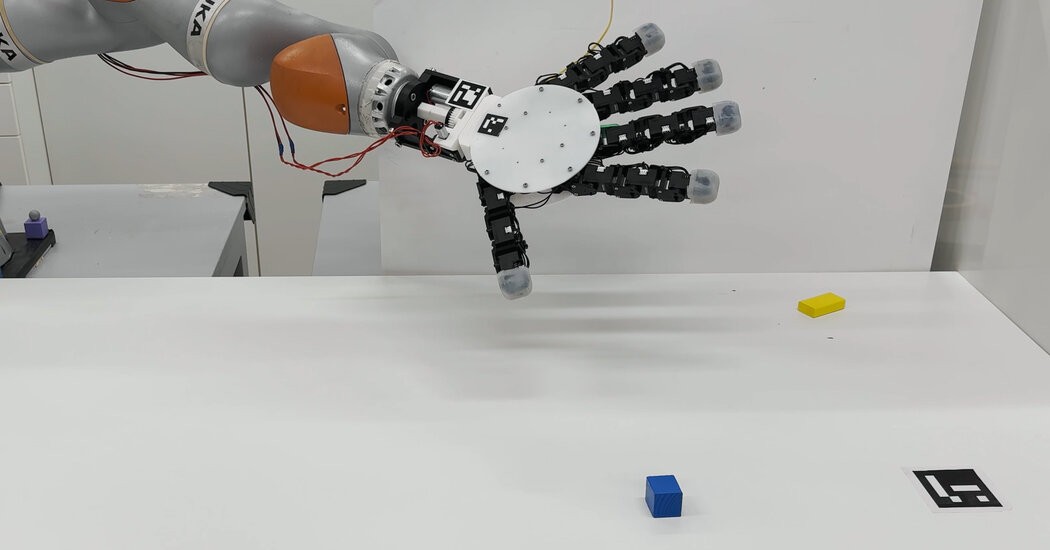
Researchers at the Swiss Federal Institute of Technology have unveiled a novel robotic hand design that surpasses human capabilities in certain grasping tasks. The device, resembling the disembodied hand from The Addams Family, is capable of detaching from its robotic arm, independently moving to grab multiple objects, and reattaching for continued operation.
The Problem with Human Hands
Dr. Aude Billard, a roboticist and mother of three, observed that the human hand is surprisingly limited in real-world scenarios where multiple objects must be manipulated simultaneously. Unlike the robotic design, humans struggle with complex motions needed to grasp items behind or to the side without rotating the entire body. This inefficiency motivated the creation of a more versatile tool.
How the Robotic Hand Works
The robotic hand consists of a disc-shaped palm with attachable, identical fingers constructed from silicone, motors, and 3D-printed components. The design allows for adaptability in grasping various shapes and sizes. The robot learns optimal grip strategies through simulations before executing them physically.
Why This Matters
This development is significant because it highlights the limitations of biological designs in specific mechanical tasks. While human hands excel in tactile feedback and fine motor control, they are less efficient when dealing with multiple objects or awkward orientations. The robotic hand offers a potential solution for industries such as manufacturing, logistics, and even assistive robotics for individuals with limited mobility.
The resemblance to Thing from The Addams Family was purely coincidental: neither researcher was familiar with the character until after the robot’s design was complete. Despite the accidental aesthetic similarity, the device represents a step forward in robotic dexterity and may redefine how machines interact with the physical world.
This innovative robotic hand demonstrates that in certain applications, artificial designs can outperform natural ones, pushing the boundaries of what machines can achieve.