
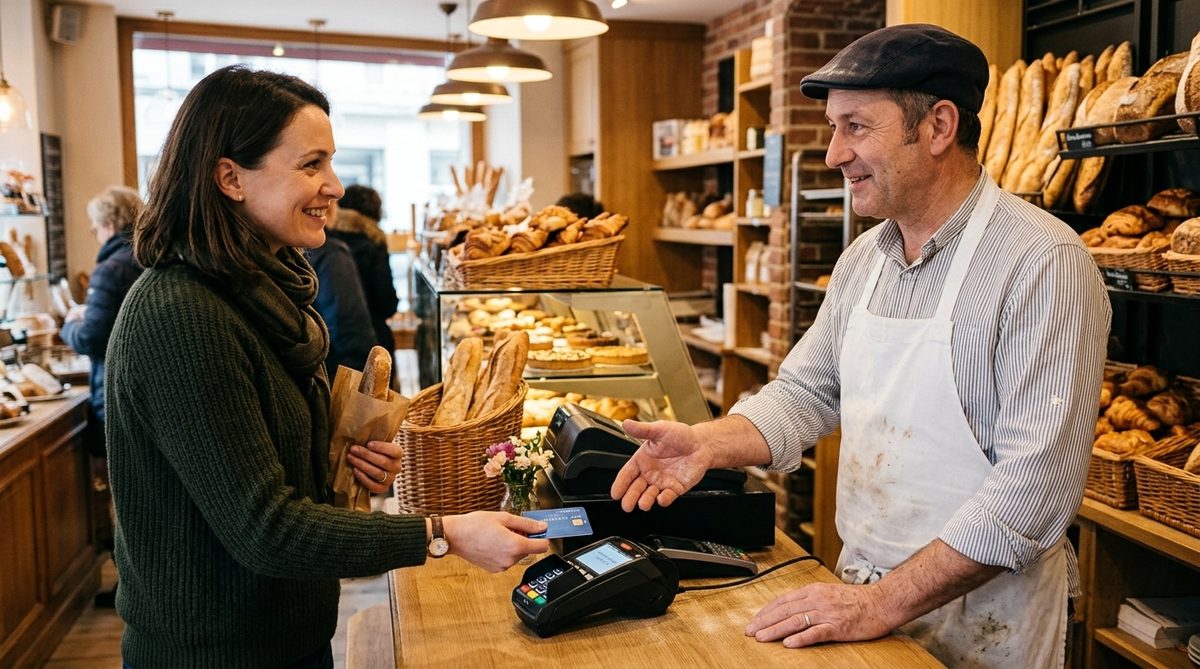
It’s a familiar morning ritual. You’re walking to the bakery, the sun is out, and you just want a fresh croissant. You tap your card on the terminal. It declines. Or worse, you see the little sign: Minimum €5 for card payments.
Your immediate reaction is annoyance. Why can’t they just take the money? It feels arbitrary. It feels like they are trying to avoid you.
But look closer. This isn’t about customer hostility. It’s about basic arithmetic.
French law doesn’t force a physical shop to accept electronic payments at all. They only have to if they display their payment logos clearly and without hidden exclusions. If they don’t display them, or if they post a clear minimum threshold before the transaction, they are within their rights.
So why the barrier? Because the math simply doesn’t work for small transactions.
The Hidden Cost of Tapping Your Card
When you swipe or tap, a complex financial engine kicks in. You see a number deducted from your account. The baker sees a number deposited. But the space in between? That disappears.
It doesn’t vanish into thin air. It goes to three parties: the baker’s bank, the card network, and the issuing bank.
The baker has signed an acquisition contract with their bank. This document dictates exactly how much they pay on every single transaction. For a small business with thin margins, these fees are a constant leak.
A sign saying “No cards under €5” is essentially a financial shield. It prevents the accumulation of tiny losses that would otherwise drain the register.
Then there is the hardware. That little terminal isn’t free.
Monthly rental fees for the device. Security updates. Dedicated internet or phone lines to process data. These are fixed costs. To amortize them, the business needs enough volume to make the equipment worthwhile. Accepting a €1 payment on that machine might not even cover the monthly lease cost allocated to that single transaction.
How Bank Fees Destroy Margins on Small Purchases
The fees aren’t just a flat rate. They are a stack of percentages that pile up quickly.
Here is where the money goes:
- Bank Margin: The baker’s bank takes between 0.3% and 1.75% of the sale. This varies based on the deal and the size of the business.
- Network Fees: International processing networks charge an extra 0.1% to 0.2%.
- Interchange Fee: EU regulations cap this, but it still applies. It’s capped at 0.20% for debit cards and 0.30% for credit cards.
Do the math on a simple baguette or a €1 pastry.
On a €5 transaction, those hidden fees can total around 11 cents. That might seem small. But on a €1 item, those fees can exceed the entire profit margin.
The baker works all night. They buy flour, butter, yeast. They pay rent. When that €1 sale happens via card, the banking system takes a bite so large it wipes out the profit. In some cases, the baker actually loses money on the transaction once you factor in the cost of goods and the fees.
Accepting the card for tiny items isn’t just unprofitable. It’s financially suicidal for a small artisan.
The sign near the counter isn’t a rejection. It’s a survival mechanism. Without it, the cost of doing business electronically would eat the business alive, one croissant at a time.
And yet, as digital payments become the default, the friction remains. We want convenience. They need viability. The gap between them is measured in fractions of a percent—and it’s getting wider.
The hidden cost of digital payments on local trade
It is easy to forget that a small business operates like a delicate ecosystem. Remove the right nutrients, and the soil turns barren. For a local artisan, that soil is cash flow. The administrative burden is relentless. To survive, shop owners must manage every transaction with surgical precision. Many choose to join an approved management center to handle the heavy lifting of accounting. This partnership comes with rules. One of them is mandatory: you must offer non-cash payment options. Usually, this means a card terminal or checks.
But legal compliance does not mean financial suicide.
There is a critical distinction between accepting modern payment methods and absorbing their costs entirely. These processing fees are invisible drains. They eat into margins that are already razor-thin. Imposing a minimum purchase limit for card payments is not an act of hostility. It is a survival mechanism. Without this barrier, small businesses would be forced to inflate prices on everyday goods—flour, sugar, bread—just to cover the transaction fees. That would hurt the neighborhood. That would drive away regulars.
Why minimum limits protect local viability
The sign near the register saying “cash only under $10” is often viewed as an inconvenience. It slows things down. It complicates the checkout. But look closer. This barrier is a shield. It protects the artisan from the aggressive fee structures of large payment networks.
Here is the reality of the numbers. Credit card processing fees typically range from 1.5% to 3.5% plus a fixed per-transaction cost. On a $2 item, that fee might be 50 cents. That is a quarter of your revenue. On a $50 item, it is manageable. On a $5 item, it is catastrophic. If a baker accepts a card swipe for a baguette, they might keep only a few cents after fees. They cannot raise the price of the baguette by 50 cents because customers will simply stop buying from them. They will go to the supermarket.
By setting a minimum amount, the business ensures that each transaction covers its processing overhead. It keeps the core products affordable. It maintains the price integrity that the community relies on.
The trade-off between convenience and independence
We are moving toward a cashless society. It is efficient. It is fast. But it is not neutral. It favors volume. It favors large margins. Small-ticket transactions, the lifeblood of many local services, become unprofitable under standard digital payment models.
Keeping physical cash in circulation is no longer just a preference. It is an economic act. When you combine small purchases into one larger bill, or use exact change, you are supporting the viability of that local business. You are helping them stay open. You are preventing the gradual erosion of the high street into a homogenized landscape dominated by chains that can absorb these costs.
The question is not just about convenience. It is about who gets to set the terms of trade. Will the independence of local shops depend on their ability to resist the total digitization of money? Or will they be priced out by the very tools meant to help them? The answer lies in the coins in your pocket. And in your willingness to use them.