Something is shifting in how federal agents define a threat. It is not just about bombs or bullets anymore.
US law enforcement is now flagging anti-technology extremists as a domestic target. The fear isn’t abstract. It follows attacks on CEOs. It follows protests against data centers. It follows the very real anxiety that AI might steal your job.
WIRED obtained more than 1,000 unpublished pages of intelligence. The sources? Department of Homeland Security. The FBI. State fusion centers.
The pattern is clear. A broad, vague category is being weaponized to surveil anyone who hates tech enough to be considered dangerous.
A Presidential Blueprint
This isn’t happening in a vacuum. It follows directives from the White House.
President Trump issued National Security Presidential Memo 7. It told the Department of Justice to go after anyone holding “anti-American” or “anti-capitalist” views. Sebastian Gorka the administration’s counterterrorism lead recently named left-wing extremists as one of three top priorities.
Put them together?
You have the surveillance apparatus of the US government aimed at speech. Specifically, speech that challenges the ideology in charge. This new “anti-tech” label fits right into that framework. It expands the list of enemies for an administration that has poured millions of political and material capital into AI proliferation.
The Fear of the Machine
One document from the New York Intelligence and Counterterrorism Bureau stands out. It predicts chaos.
“The chaotic atmosphere that may result from emergend AI technology… may fuel large-scale protests that devolves into civil unrest and anti-tech violent extremist activity,” the report claims. It names New York City as a likely hotspot.
Notice the term? Anti-tech violent extremism.
You will not find it in any public FBI guideline. It is new. It lumps disparate ideologies into a single basket of fear.
The bureau also points to a specific incident: the arrest of Ziz Laota. He ran a small, cultlike group tied to the extreme rationalist movement. Three members are charged with murder. Their obsession? The existential risk AI poses to humanity.
It sounds paranoid. To the bureau, it is proof.
The assessment warns that Laota’s trial could spread these views. That people will believe a godlike AI is imminent. That humans must align the machine or face destruction.
Is it extreme? Yes.
But are these fears isolated to criminals? No. AI engineers debate them. Frontier tech companies hire alignment experts to solve them. Yet here the intelligence apparatus treats the underlying anxiety as a precursor to violence.
Chilling the Dissent
This tactic is not new to policing. It has a history of monitoring people just for talking.
Last year the FBI monitored Signal chats of volunteers tracking immigration court hearings in New York. They called them “anarchist violent extremist actors.” One of the categories in the new strategy.
Now 80 fusion centers sit across the country. They are the glue between federal intel and local police. And they are busy.
A report from Western Pennsylvania warns that “adversarial actors” might hit US data centers. They mention state-sponsored groups. Criminal gangs. Homegrown violent extremists. Environmental activists.
The logic gets slippery. These actors might “exploit the strategic importance of data centers” to mine crypto. Or use front companies. Or gain access to infrastructure.
Then look at Northern Virginia.
Their report targets AGAAVEs—anti-authority violent extremists. These folks plan attacks based on grievances and conspiracies.
Here is the catch.
The list of suspicious indicators? Observation. Surveillance. Photography. Testing security. Attempted intrusion.
These are things peaceful protesters do. Legal experts say these reports are unreliable by design. They allow bias to fill in the blanks.
“These reports are incredibly unreliable” Spencer Reynolds of the NAACP Legal Defense Fund notes. “Officers can inject their own biases. They see what they want to see.”
Who responded to WIRED’s request for comment? Nobody useful.
The FBI offered a standard statement: They investigate individuals who intend to commit violence. That is their mandate. The DHS said nothing.
Private Eyes and Public Speech
The surveillance goes deeper than government offices. Private intelligence firms are helping.
In January 2025 SITE Intelligence—a for-profit firm that scans the web—sent bulletins to fusion centers. They flagged a Discord server labeled “neo-Luddite.” One user called for violence against tech CEOs.
SITE makes millions mining anonymous online chats. The job is nearly impossible. You are trying to read intent from slang inside jokes and vague rants.
“This activity tends to focus on views about policing, abortion economic inequality,” Reynolds argues. He thinks SITE is just amplifying noise.
Rita Katz founder of SITE disagrees.
By narrowing focus she says they can find value. Even trolling has data weight. Their reports show a spike in online threats to sabotage data centers. And that is a real concern.
But what counts as sabotage?
The Northern Virginia center tracked events like the “Tesla Takedown” protests. Also the “Break Up With Tech Rager.” Organized by Eject Elbit an activist group pushing back against military tech contractors.
These are constitutionally protected assemblies. They were tracked nonetheless.
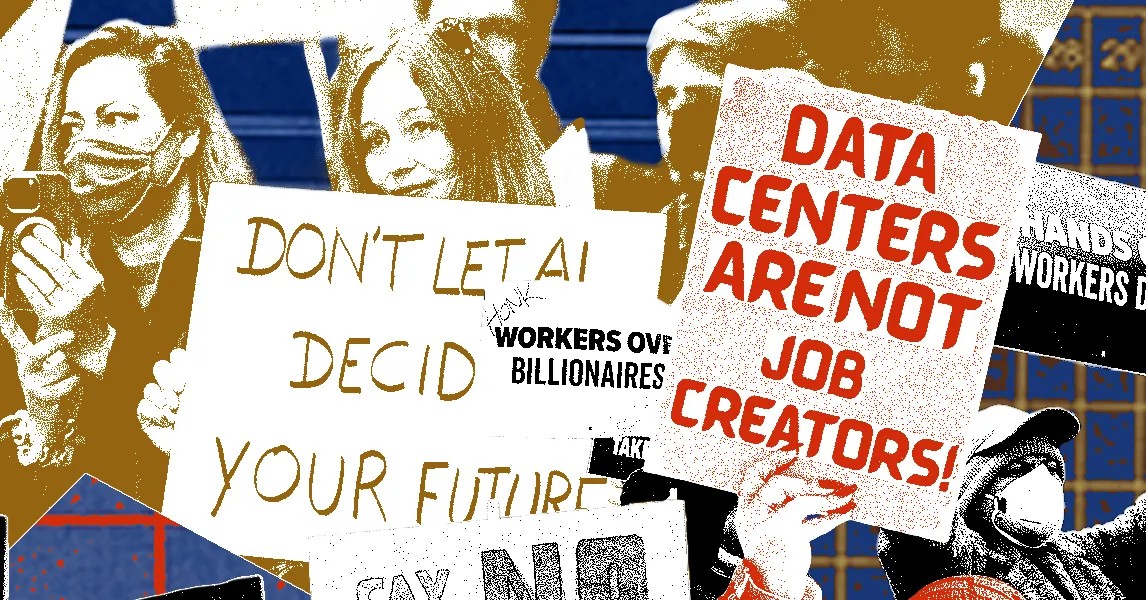
Fusion centers are watching town halls. Budget meetings in Arlington Fairfax and elsewhere. Across 42 states hundreds of groups have organized to stop local data centers from rising in their neighborhoods.
Data Center Watch tracks this opposition. It is often messy. Contentious. In several states including California Illinois and Oklahoma police arrested speakers criticizing tech builds. Some before they even said a word.
What Is the Crime?
Under US law “domestic terrorism” is not a standalone charge you get slapped with at trial. It is a tool for investigation. A label that allows enhanced surveillance.
So the activists don’t get charged with terrorism. They get charged with criminal trespass. Vandalism. But the label sticks.
Enter Mauro Lubrano.
An extremism researcher. He wrote Stop the Machines. His book maps out the anti-tech threat: insurrectionary anarchists. Eco-extremists. Ecofascists. He groups the followers of Ted Kaczynski with German anarchists and Mexican eco-groups. He argues they share a goal. Violence to achieve ideological aims.
Lubrano was invited to lecture at fusion centers. He is happy the warning is taken seriously. Anti-tech violence is wrong.
But he worries.
The framework is blunt. It might silence criticism of the current tech trajectory under the guise of security.
Reynolds agrees.
The definition is too wide. It can snare peaceful protesters. AI skeptics. Anyone with a complaint about a data center being built near their kid’s school.
We have seen this movie before. With Black Lives Matter. Occupy Wall Street. Environmental movements.
As people organize for a future they like they become targets.
The machine watches.
It labels.
And the boundary between dissent and extremism grows thinner.