
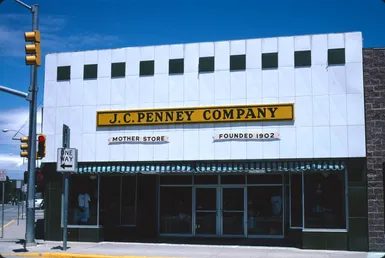
The first J.C. Penney store opened in Kemmerer, Wyoming, in 1902. James Cash Penney and his partners launched the Golden Rule dry goods store on April 14 of that year. They expanded quickly to other Wyoming towns. By 1907, Penney bought out his partners. He was building a retail empire that would last a century.
Now, the company sits in a precarious position. It is owned by two real estate giants: Simon Property Group (SPG) and Brookfield Asset Management (BAM). This ownership structure changes everything about how JCPenney operates. It is no longer just a retailer. It is a tenant in malls owned by its landlords.
This dynamic explains why the company survived the 2020 bankruptcy when many others did not.
From Dry Goods to Department Store
JCPenney incorporated on January 17, 1913. It was called J. C. Penney Stores Company. Thirty-four stores already existed in the American West. The following year, headquarters moved to New York City. The company went national.
By 1929, JCPenney had 1,392 stores. Shares began trading on the New York Stock Exchange that same year.
James Cash Penney retired in 1946. He kept the title of honorary chair. His conservative influence remained. Employees could not use tobacco or liquor. This strict culture defined the brand for decades.
The company changed its selling model in 1958. It shifted from cash-and-carry to store credit cards. This allowed JCPenney to broaden its merchandise. It needed to compete with Sears and Montgomery Ward.
Mail-order sales started in 1962. JCPenney acquired the General Merchandise Co. The first Penney Catalog launched the next year.
International Ambitions and Pharmacy Expansion
The late 1960s saw JCPenney look abroad. It acquired Sarma, SA, a Belgian retail chain. It entered the Italian market in 1971. These stores operated under the name JCPenney, SpA. The company sold them in 1977.
Pharmacy became a major focus in 1969. JCPenney bought Pittsburgh-based Thrift Drug. The expansion continued for decades.
In 1996, the company acquired Eckerd Drug Corp. This chain operated more than 1,700 stores in 23 states. JCPenney then ran 2,800 retail pharmacies.
Headquarters moved to Plano, Texas, in 1988. The company moved 3,600 corporate employees from New York City. It located near Dallas.
Overseas expansion reached Mexico and Chile in 1995. The international merchandising division closed in 2003.
The Decline Begins
Sales stagnated as the 21st century approached. Discount stores like Target and Walmart took market share. The 2007–08 financial crisis accelerated this trend.
JCPenney tried several strategies to revive the business. They mostly failed.
Partnerships and brands.
In 2006, JCPenney partnered with Sephora. The beauty brand opened outlets inside select stores. Sephora ended the contract in 2020. It left the retailer entirely.
In 2008, JCPenney introduced American Living. Fashion designer Ralph Lauren developed the brand. The partnership lasted until 2012.
Product diversification.
The company added Linden Street home furnishings. It launched clothing lines for juniors and young men.
Channel shifts.
JCPenney recognized the rise of online shopping. It discontinued catalog sales. The company also sold its fleet of Eckerd Drug stores in 2004.
These moves aimed to position JCPenney competitively. Sales continued to lag. The online presence failed to gain ground.
One specific failure stands out. In 2012, the company tried “fair square pricing.” It eliminated discounts and promotions. Sales plummeted.
CEO Ron Johnson was replaced. Myron Ullman took over. JCPenney returned to its old pricing model. It was too late to save the momentum.
The 2020 Bankruptcy
The COVID-19 pandemic delivered the final blow. Nationwide lockdowns closed virtually all stores.
In May 2020, JCPenney’s holding company filed for Chapter 11 bankruptcy protection. The company carried $4 billion in debt.
At its peak in 1973, JCPenney operated more than 2,000 stores. By the time of bankruptcy, the count had fallen to 846.
Restructuring and New Ownership
During bankruptcy, JCPenney closed more than 200 stores. It restructured its debt.
In late 2020, Simon Property Group and Brookfield Asset Management purchased the company for $800 million.
Why did these two entities buy a struggling retailer?
It is a strategic move. Both SPG and BAM own hundreds of malls and shopping centers across the U.S. An anchor retailer closure would leave these properties vulnerable. Keeping JCPenney open helps stabilize their real estate portfolios.
Marc Rosen became CEO in 2021. He previously held executive roles at Levi Strauss & Co. and Walmart.
Rosen began remodeling stores. The plan is to spend more than $1 billion by the end of 2025. The goal is to keep the stores and e-commerce site alive.
The company traces its origins back to a single dry goods store in Wyoming. It has survived wars, recessions, and retail revolutions. But the era of JCPenney as an independent giant is over. It now exists as a key tenant in the malls that define American shopping.
The question remains whether the $1 billion renovation can reverse the decline. The retail landscape has changed. Consumers have moved on.