
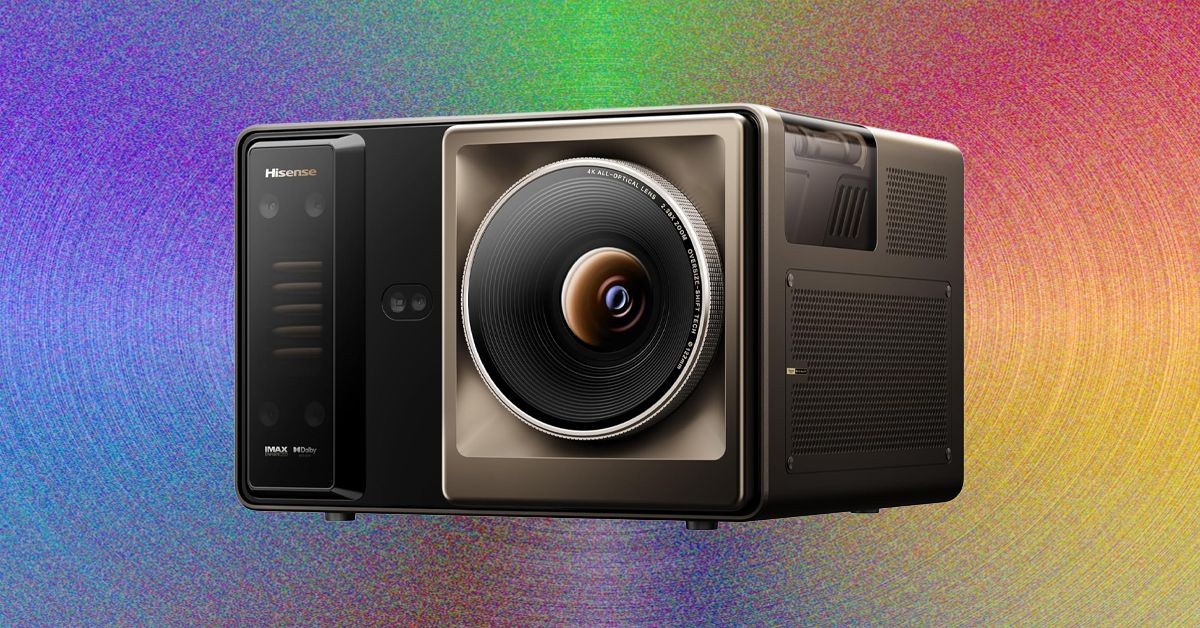
RGB backlighting is currently the shiny object everyone in the TV industry wants to look at. Brighter. More colors. Now it is bleeding over into projectors. The Hisense XR10 steps into that ring claiming 6,000 lumenes. It also boasts a native contrast ratio of 6,000:1 and an adjustable iris. It promises a sense of wonder. Whether you actually get it depends heavily on what you feed it.
Heavier Than You’d Think
The XR10 is not cute. It is heavy. At 23.4 lbs it feels like a commitment when you lift it out of its case. Even compared to the 18-lb Xgimi Titan Noir Max, the weight pinch in your back is real. It looks good though. Just one dark metallic cube. A bronze faceplate on the front does nothing but look cool. Four tiny feet let you make micro-adjustments. Many newer projectors only have feet in the front so the Hisense approach allows more height tweaking.
Setup was straightforward enough. Auto-keystoning mapped the image to my screen without a fight. Occasionally I had to manually tweak focus. Better than the Epson Lifestudio which takes forever to correct itself.
Hisense runs the VIDAA OS. It feels familiar if you have used the Leica Cine Play. Most people see it only on Hisense gear. The Titan Noir Max doesn’t even have an OS which actually makes sense. Just buy a Fire Stick or Google TV dongle for fifty bucks and be done with it. Getting the XR10 running took ten minutes total. Installing apps, fixing the keystone. Simple. The one annoying omission is Fandango at Home. I rent early movies there. Its absence is a slight itch.
Heat management uses liquid cooling. This kept the fan relatively quiet during tests. Loud fans ruin movies. The XR11 did not. The built-in speakers are also surprisingly clear. A nice surprise since most projectors sound like cardboard boxes.
Connectivity is solid but flawed. Three HDMI ports. Only two support HDMI 2.1 speeds. The middle one handles eARC passthrough. I had a rough time here. Dropped audio. Black screen flashes. Glitches with my Onkyo receiver. Hisense says they are looking into it. I remain skeptical. You do get Ethernet. Two USB ports. Optical and 3.5mm audio. Wi-Fi 7 ensures future-proofing at least.
The remote is a mixed bag. Too busy. Three buttons just for settings seems excessive. But I liked the dedicated brightness button. Backlit. Centered home button. In a dark room that helps immensely.
Chasing Perfect Color
How does it compare to the Titan Noir Max? That is the question everyone asks. The Titan usually wins on paper. But the Hisense fights dirty. It hits 118% of the BT.202 color gamut. The Titan hits 110%. The catch? The Titan adjusts its iris on the fly as scenes change. The Hisense does not. You pick one of seven preset iris levels manually. It changes how dark shadows appear. Tweak the settings buried in the menu and the picture improves.
Watching Awake on Netflix proved this point. The show is intentionally dark. People who can’t sleep. Life-like darkness. Budget screens turn it to gray mush. The XR10 kept details crisp. Even a guy in a dark blue shirt stayed visible. On the Titan it looked a bit duller.
Color pops. Seriously pops. Inside Out and Guardians of the Galaxy Vol 2 look phenomenal because they support that same color spec. Explosive aliens. Vibrant emotions. Rusty dark reds usually fail on screens. Here they looked rich. The Creator also held up well. Predawn beach scenes often lack texture on midrange gear. The XR10 showed rocky cliffs and wetsuit details without turning the image into noise.
Technical benchmarks are where things get muddy. Skin tones were good. But not LG Micro RGB good. Not Titan good. White mist over a mountain looked slightly blurry compared to top-tier rivals. Yellow flowers against dark trees felt artificial. Then you see green grass behind a fence or steam rising from a spring and you forget the flaws. Those look amazing.
Daytime viewing is the weak link. Crank up the brightness? Everything looks washed out. Blue lights on Britbox looked gray. Hisense’s website hints that you should open your shades. Bad advice. High-end projectors struggle with daylight. This is one of them.
Games and Voices
Switching to video games changed the perspective entirely. Vivid colors on a big screen make games sing. Hellblade II on Xbox showed realistic water on arms and rocks. Contrast held up. No washing out. Forza Horizon 6 felt real at night. Snow. Water. A white BMW looked crisp. Not blown out. Just there.
- Crimson Desert* showed why 240Hz matters at 1080p. Every controller move felt immediate. The XR10 automatically switches to low latency mode for gaming. It helps.
News broadcasts were an interesting test. The colors were not as aggressive as some premium models. I preferred that. The CNN anchor looked like a human not an actor in a bad CGI show. Adjusting the iris softened the blooming. A World Cup pitch was green not glaring neon.
Voice control is underwhelming. Ask to increase brightness? It shows you movie recommendations instead. Ask what app Carrie is on? You get a plot summary. The AI text response is baffling at best. Give me Alexa or Google.
So where does it sit? Upper echelon. Sure. The Xgimi Titan might win on benchmarks and dynamic iris technology. But for most movies I tested the two were neck-and-neck. I preferred the Titan’s auto-iris. But the Hisense XR10 punches above its weight class. Just don’t turn on the lights.