
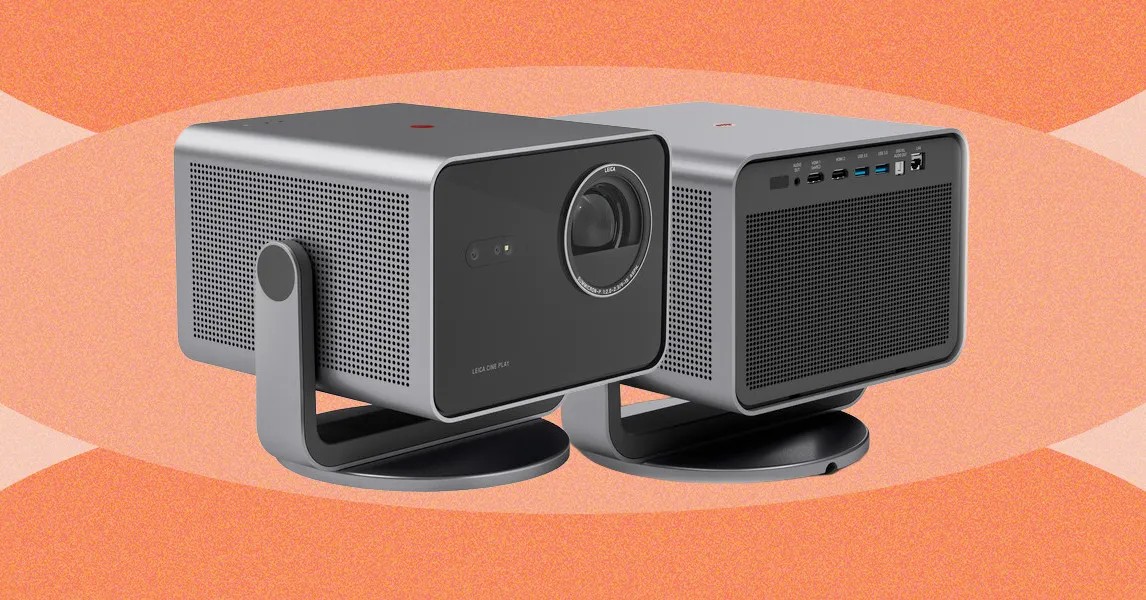
Leica doesn’t do things half way. They make cameras that people worship like religious icons, now they’ve made a projector that looks just as pretentious and just as beautiful. It is called the Cine Play 1 and it costs a fortune. Specifically it is $2995 after you hunt down an $800 rebate. That is steep for a gadget that requires you to live in the dark but the picture quality makes you forgive a lot of things.
It is aluminum. It has glass. It has that famous red dot. It looks like something a wealthy person would buy to signal taste rather than just need.
Setup is Easy. Moving it isn’t.
It weighs 14.6 lbs. That feels portable until you realize it needs power. Always. No battery means you are tethered to an outlet, tethered to indoors. You can buy a fancy floor stand for another $495, which connects power through the base so your cables aren’t ugly. It is Apple thinking. Expensive but clean.
Set it up about 12 feet from a wall. You get a 150-inch screen. The lens is a Leica Summicron, same branding as their cameras, which promises sharpness without the color fringing that ruins lesser projectors. It keeps that promise.
The auto-keystone adjustment works. Almost magic, really, until you bump into it and the sensors panic. Then you turn it off. The interface is Hisense’s VIDAA. It is intuitive enough. Voice search works if you hate menus. But Fandango at Home is missing. Maybe it comes later. Maybe it doesn’t matter.
“The focus, brightness, and color were all above average.”
That is a generous understatement for the image itself.
Colors That Scream. Blacks That Whisper.
Turn the lights out. Not just dim them. Out. This projector demands it. It boasts 3000 lumens, which sounds high on paper, but compared to Epson’s LS9000 it struggles in ambient light. Epson wins there. Leica wins everywhere else in a dark room.
The colors? Unreal. The BT.2020 spec says it covers 107%. That means when Avatar: Fire and Ash plays, the blues are deep, the reds are aggressive. Skin tones don’t look like paper. In the butterfly scene from my test clips, the difference between yellow and orange is subtle enough to stop your heart. It feels wet. It feels real.
Gaming? Sure. Plug in an Xbox or a PC. It does 120Hz at 1080P. Forza Horizon 5 looked better on the wall than it does on a TV. No stutter. Just motion. But you lose a HDMI port if you use the audio output. A minor tragedy. You only get two HDMI inputs total. For a three grand machine? Stingy.
There is no antenna input either. No coax. You stream. Or you use an app. Or you live with the limitations.
The Remote is an Afterthought
Why did Leica fail the remote?
It has no backlight. In the dark room where you need the projector the most, you are feeling around for buttons. The dedicated app keys are locked. You can’t map them. If you hate Disney Plus you still have a button for it. You cannot remove it. I wanted the back button on the left. It is on the right.
Use the phone app. VIDAA lets you. Or buy a new remote. But it shouldn’t cost extra.
Art mode exists, sort of. You load a photo of a Van Gogh onto your phone. You beam it on the wall. It is nice for twenty minutes. Until your eyes burn or you remember you are paying $3000 to stare at static JPEGs. It is not true art mode like Samsung does, where it runs all day without overheating the lamp. But for a nightcap? Sure.
Is It Worth The Cash?
You could buy a 4K TV for less. You could buy the Epson LS9000 for slightly more and have it work during a basketball game with the lights on. You could buy the Hisense equivalent for a grand less and get the same shape.
But this is Leica. It is the Summicron lens. It is the way Predator: Badlands looked moist and alive on your dry drywall. It is the immersion that hits you when you are sitting three rows back in your own living room.
If you care about color above all else if you hate bright rooms and if you have money to burn then yes. It delivers.
It just leaves the question hanging about those HDMI ports.
Why stop at two?