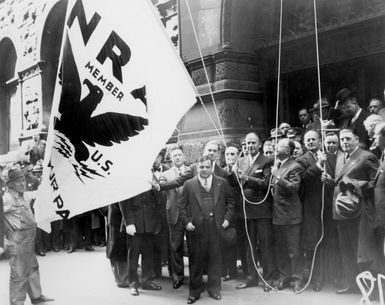
Fiorello LaGuardia’s appearance in the middle of the flag ceremony in April 1934 seemed like a moment of victory. It wasn’t. This photo, taken outside the National Recovery Administration’s New York headquarters, depicts the peak of an experiment that was quickly declared unconstitutional. There is a blue eagle logo in the screen window, which promises cooperation. It also promised a quick fix to the Great Depression. That fix never came.
Franklin Roosevelt created this government agency to jumpstart the stalled economy. He needed a mechanism to regulate the industry without triggering a political backlash against direct government control. The National Industrial Recovery Act of June 1933 provided the legal framework. This would give the president the authority to create industry-wide regulations. The goal was simple on paper. Eliminate unfair trade practices. Reduce unemployment. Set the minimum wage. Cap maximum hours. Guarantee the right of labor to bargain collectively.
The machinery moved fast. The agency produced 557 basic codes. It added 208 supplementary codes. These regulations affect the lives of approximately 22 million workers. Companies that signed up got to display the Blue Eagle. It became a symbol of patriotism and compliance. If you look at the eagle, you know the industry is following new rules.
But the rules were messy. They were drawn in haste. They were overly complicated. They often serve the interests of large companies at the expense of the direct interests of consumers and small traders. The codes lacked flexibility. They fix prices and production levels in ways that prevent competition. Small and medium-sized entrepreneurs cannot compete with large business cartels. Consumers faced higher prices. The promised recovery stayed just out of reach.
The guidelines were hastily drawn up, overly complicated and reflect the interests of big business at the expense of consumers and small traders.
Despite the structural deficiencies, the state agencies forced to change the working conditions. It pushed for better wages in certain sectors. It provided a shield for workers who tried to unionize. The guarantees of collective bargaining give the labor movement new leverage. Its influence lasted long after the organization itself ceased to exist.
The end came unexpectedly in 1935. The Supreme Court invalidated the NRA. The justices felt that the bill gave too much legislative power to the executive branch. It also transcends interstate commerce under the Constitution. The legal basis is being destroyed. Institutions cease to exist.
With that, many provisions did not disappear. Congress incorporated these concepts into subsequent legislation. The Wagner Act of 1935 protects the right to organize. The Fair Labor Standards Act established the minimum wage as we know it today. The first experiment failed as a means of immediate economic recovery. It became the model for modern workers’ rights. The blue eagle disappeared from the shop window. The tested legal principles remain unchanged.
Symbolism in depression
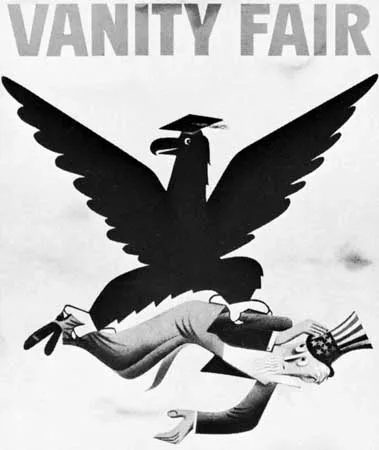
The image is heavy. Not just because of the ink in the newspaper, but because of what it represented at the time. In September 1934, the Great Depression hit America deep in the ribs. The unemployment rate is still around 25 percent. Trust in the federal government is not only shaky; The seams frayed.
Go to the National Recovery Administration.
The NRA was seen as an antidote to the free fall of the early 1930s. This was the basis for President Franklin Roosevelt’s New Deal, which aimed to restart the industrial engine by setting standards of fair competition. These norms regulate prices, wages and working hours. The goal? Stop the race to the bottom.
The symbol of this initiative is a blue eagle.
It’s everywhere. Fasten the collar. Let’s paint the shop. Please print this on your invoice. This is a visual must for Buy American as it supports the government’s efforts to stabilize prices and shows that your business is in compliance with the new regulations. The pictures are also well thought out. Blue Eagle grabs the lightning bolt and picks up Uncle Sam. It means strength. This shows that the government supports its people and prevents a collapse that the market alone cannot fix.
But a symbol is just ink until it is mechanically supported. The structure of the NRA was flawed from the start.
How Blue Eagle is changing consumer behavior
To the average shopper in 1934, the blue eagle was more than just a logo. It was a trust signal.
Look for this sign when you go to the grocery store or hardware store. We are committed to fair wages for employees and fair prices for consumers. He promised the owners not to take advantage of the turmoil caused by the Great Recession. The government practically created a stamp of approval that became a marketing tool overnight.
It’s not just patriotism. It was economic survival for businesses.
Failure to display the Blue Eagle logo will result in you being flagged as a non-compliant operator. You are part of the problem. In an environment where customer loyalty is weak and profits are thin, being labeled a “scab” business by the state is a death sentence. The NRA has the power to blacklist companies that break the rules. Being blacklisted means they are excluded from public contracts and, more importantly, shunned by consumers who want to participate in the economic recovery.
Blue Eagle is a powerful consumer guide that translates government policy into everyday purchasing decisions.
Why systems break down under their own weight
This is a problem when trying to plan a return through a coding committee. Not everyone wants the same thing.
The NRA allows the industry to create its own regulations. This led to massive inconsistencies. The salary limits of a textile manufacturer in the north may differ from the salary limits of a mining company in the west. Big companies with legal teams and lobbying power often create rules that favor their size and effectively crowd out smaller competitors in the name of “leveling the playing field”.
The purpose is to prevent deterioration. The reality was often collusion.
Critics argue that the NRA is artificially raising prices. If everyone agrees to stop cutting wages and prices, consumers will have no choice but to pay more. For those already desperate for cash, this feels more like a tax on desperation than a recovery.