
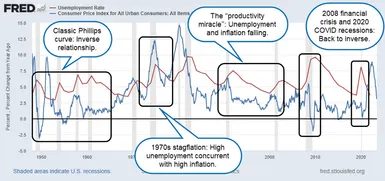
Classical economic models that explain the relationship between unemployment and rising prices are crumbling under the weight of real-world data. For decades, decision makers and students have relied on the Phillips curve as a reliable compass. This promises a simple inverse relationship. In other words, if we want to reduce unemployment, we have to accept higher inflation. If we want price stability, we have to accept unemployment.
This compromise is useful. It was also wrong.
Original theory: simple wage mechanism
The concept was developed in 1958 by the New Zealand economist William Phillips. He analyzed British data from 1861-1957. His discoveries were concrete and profound. In other words, the rate of change in money wages was closely related to the unemployment rate.
The logic is simple. A low unemployment rate means a labor shortage. The company needs to hire people. To attract talent, you need to offer better compensation. Rising wages raise production costs, and companies tend to pass these costs on to consumers in the form of higher prices. Inflation rises.
On the other hand, when unemployment is high, the bargaining power of employees weakens. Wage growth has stopped. Inflation has cooled.
Phillips pointed to one notable exception: a sharp rise in the price of imported goods. But after that the curve continued after the war. This shows that economies can choose their station with frequency. Low inflation can be associated with high unemployment or low unemployment can be associated with high inflation. In the long run, you can’t have it both ways.
Stagflation: the collapse of the model
The 1970s shattered this illusion. The US experienced “stagflation”. This is a Keynesian economist’s nightmare scenario. This means high inflation and high unemployment at the same time.
If the Phillips Curve were a strict law of nature, this should not be possible. The data just doesn’t fit the model.
This theory not only failed in the 1970s; I’m still disappointed. In the early 2000s, the United States experienced a period of low unemployment and relatively low inflation. The inverse correlation disappears. Why?
There are several factors that disrupt the simple wage-price cycle.
- Supply-induced shocks: Events like the oil crisis can cause prices to rise regardless of the number of people working.
- Inflation Expectations: When companies expect prices to rise, they proactively raise wages and prices to break the link with the current unemployment rate.
- Technology: Former Federal Reserve Chairman Alan Greenspan spoke of the “productivity miracle” of the late 1990s. The development of technology has given companies the opportunity to produce more with fewer employees and keep wages under control even in a tight labor market.
Criticism of the Austrian school
The collapse of the Phillips curve was more than a statistical anomaly. It became a theoretical battlefield. Economists at the Austrian School of Economics believe that this model is fundamentally flawed.
They argue that the Phillips curve is based on mathematical assumptions and ignores the fundamental forces driving the real economy. For them, the stagflation of the 1970s was more than an anomaly. It was proof that the theory was unreliable. They argue that government intervention to manipulate the unemployment rate creates more distortion than stability, rendering this compromise obsolete.
The bottom line of financial decisions
Does the death of the Phillips curve mean that macroeconomic models are useless? No, it means we have to dig deeper.
On the surface, this theory makes intuitive sense. Labor supply and demand change pricing power. But the real world is messed up. Employment and inflation are driven by complex factors such as global supply chains, technological change, monetary policy and consumer sentiment.
Correlation between unemployment and inflation is not causation. There is no guarantee that it will last longer.
This is an important distinction for investors and business managers. Relying on simple trade-offs can lead to fatal misjudgments. Low unemployment does not guarantee an acceleration of inflation. High inflation does not mean that the labor market is weak.
The old map no longer matches the territory. Understanding the nuances is the only way to navigate the current economic situation.